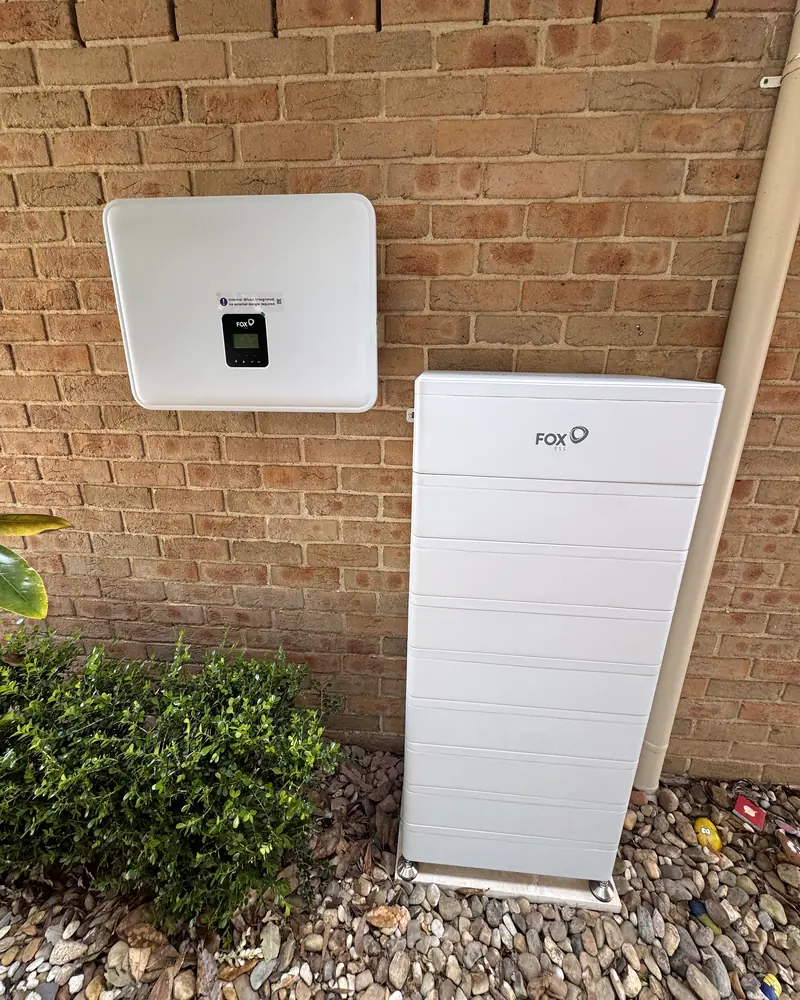
Home batteries have gone from a niche product to one of the most common questions we get. Government support has made them more affordable, but "more affordable" doesn't automatically mean "worth it for you". It comes down to how you use power, what solar you have (or will have), and what you want the battery to do.
How a battery actually saves you money
Solar panels make the most power in the middle of the day, when many households use the least. Without a battery, that spare solar is exported to the grid for a feed-in tariff, which is usually far lower than the price you pay to buy power back in the evening. A battery stores that spare daytime solar and lets you use it after the sun goes down, when you'd otherwise be buying from the grid, often at peak rates if you're on a time-of-use plan.
So the saving from a battery is roughly the difference between what you'd pay for evening power and what you'd have earned exporting it, multiplied by how much you shift every day. That's why the answer depends so much on your household.
Who tends to get the most out of a battery
- Households with solar that exports a lot during the day. If your bill shows big exports and big evening usage, a battery has something to work with.
- High evening usage. Cooking, air con, kids home after school, an EV charging overnight: the more you use after dark, the more a battery can cover.
- Time-of-use tariffs. If evening power is expensive on your plan, every kWh the battery covers is worth more.
- People who want blackout backup. Some batteries can keep selected circuits running during a grid outage. That has value that doesn't show up on a bill, especially if you work from home or have medical equipment, a fridge full of food or a sump pump.
When a battery might not be the first step
- You don't have solar yet, or your system is small. A battery needs spare solar to charge from. Often the best move is solar first (or more solar), sized with a future battery in mind.
- Your usage is mostly during the day. If you're already using most of your solar as it's made, there's less left over to store.
- Very low usage. If your bills are already small, the saving may be modest.
None of these rule a battery out, especially if backup matters to you. They just mean the payback case is weaker, and we'll tell you that straight.
Government support: the Cheaper Home Batteries Program
The Australian Government's Cheaper Home Batteries Program started on 1 July 2025. According to the Department of Climate Change, Energy, the Environment and Water, it provides a discount of around 30% on the upfront cost of eligible small-scale battery systems (5 kWh to 100 kWh) connected to new or existing solar. The discount is delivered through the Small-scale Renewable Energy Scheme and is generally passed on by the installer or retailer, so you don't apply for it yourself.
A few things worth knowing, all from the official program pages:
- The discount depends on the battery's usable capacity, and since 1 May 2026 it tapers for larger batteries (see the Clean Energy Regulator's explanation).
- It's reviewed at least annually and is scheduled to decrease over time until 2030.
- Eligibility rules apply, including approved battery products and accredited installation. See the eligibility information.
NSW has also run its own battery incentives through the Peak Demand Reduction Scheme, which has included incentives linked to connecting a battery to a virtual power plant (VPP). Those rules have changed several times, so check the NSW page for what's current.
Our NSW solar and battery rebates guide goes through each program in more detail, and this guide has published price ranges. Amounts and eligibility change, so we confirm exactly what applies to your system in your written quote. We won't promise a discount figure until we've checked it against your actual battery and installation.
How big a battery?
Bigger isn't automatically better. A battery that never fills up (because you don't have enough spare solar) or never empties (because your evening usage is low) is money sitting on the wall. The right size usually covers a good share of your typical evening and overnight usage, and matches what your solar can realistically charge on an average day. Our savings estimator shows a rough starting point, and the detailed design is done from your bills.
Other questions to ask before you buy
- Can it work with my existing solar? Often yes, but it depends on your current inverter. Some setups need a hybrid inverter, others can add a battery with its own inverter.
- Does it include backup, and for which circuits? Backup is not automatic with every battery. Ask what will stay on in an outage.
- Where will it go? Batteries have installation location rules. We'll check your site and explain where it can safely be installed.
- What about a VPP? Some retailers and programs pay you to let them use your battery at peak times. It can add value, but read the terms on how much of your battery they can use.
- What's the warranty? Check both the product warranty and the conditions attached to it.
The bottom line
A battery is worth it when there's enough spare solar to store, enough evening usage to use it on, and you value the extra independence and backup. If those line up, government support makes the numbers a lot more attractive than they were a few years ago. If they don't, we'd rather tell you to add panels or shift some usage first.
Find out if a battery stacks up for you
Send us your details and a recent bill. We'll show you the options with and without a battery, and confirm any incentives your system is eligible for in a clear written quote.
More guides: NSW solar and battery rebates · What solar and batteries cost · How big a solar system do I need? · What is a solar PPA? · Solar for strata and commercial roofs
Government program details checked against official sources on 22 October 2026. This guide is general information only, not financial advice.