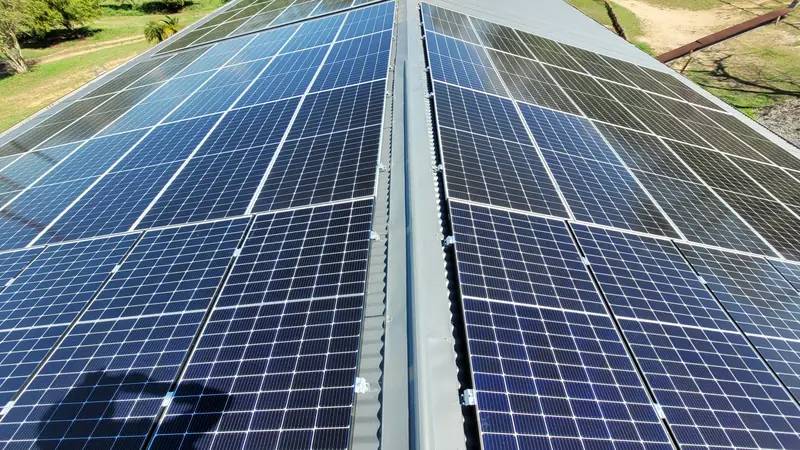
How a solar PPA works for a business, month to month
Who owns the system, what shows up on your bills, and what to read closely in the contract. A companion to our overview of what a PPA is.
In a solar power purchase agreement (PPA), a provider puts a solar system on your site at their cost and owns it. You agree to buy the electricity it makes at a set rate per kilowatt-hour (kWh). This guide is about the on-site kind, with panels on your own roof, carport or land, and focuses on how it actually runs once it's installed. If you want the basics and a step-by-step of how an agreement gets started, read What is a solar PPA, and how does it work for businesses? first.
Who does what
| Provider | Your business | |
|---|---|---|
| The system | Owns it and pays for design, equipment and installation | Hosts it on your roof or land |
| Approvals | Handles the network connection application and installation paperwork | Provides site access, bills and landlord or owners corporation consent where needed |
| Day to day | Monitors and maintains it, as set out in the agreement | Uses the power, and lets the provider reach the system |
| Your electricity retailer | Not involved | Still supplies everything the solar doesn't cover |
| Payment | Bills you for metered solar energy | Pays the agreed rate per kWh |
What a month looks like
- The sun comes up and the system starts producing. Your site uses that solar power first, as it's made.
- The grid fills the gaps. At night, on cloudy days, or when the site uses more than the system makes, the power comes from your electricity retailer, as it does now.
- A meter records what the solar system produced and your site used. The agreement should say exactly which meter is used and how the numbers are read.
- You get two bills. Your retailer bills you for grid power (hopefully less than before). The PPA provider bills you for the solar energy used at the agreed PPA rate.
The saving, if there is one, comes from the PPA rate being lower than what you'd otherwise pay your retailer for that daytime power. So the first thing to check is the rate against your current bills, including the energy and any network charges that solar actually reduces.
Surplus solar the site doesn't use may be exported to the grid. How that's treated (and who gets any payment for it) should be written into the agreement, so ask.
PPA, buying outright, or staying as you are
| Solar PPA | Buy the system | Do nothing | |
|---|---|---|---|
| Upfront cost | No capital for the system | Full cost, less any discounts | None |
| Who owns it | The provider, until any end-of-term purchase | You | n/a |
| Maintenance | Provider, as agreed | You (or a service contract) | n/a |
| Long-run saving | Usually smaller, because the provider's costs and margin are in the rate | Usually larger over the system's life | None |
| Government discounts | Go to the owner, so ask how they're reflected in the rate | You can claim them, if eligible | n/a |
| Commitment | A contract for its term | None beyond the purchase | None |
If you have the cash or cheap finance and you'll be at the site for the long haul, buying often wins on total savings. A PPA makes more sense where you'd rather keep capital in the business, or the landlord, tenant or ownership structure makes buying awkward. We'll quote both so you can compare. The commercial solar page covers buying.
Incentives that can sit alongside a PPA
The Clean Energy Regulator says the federal Small-scale Renewable Energy Scheme has been expanded for solar PV systems from 100 kW up to 1 MW (mid-scale systems installed from 1 October 2026, with applications opening mid to late November 2026). If a battery is part of the plan, NSW lists a Batteries for businesses incentive (from 1 September 2026, for non-residential batteries from 20 kWh to 30 MWh), and the federal Cheaper Home Batteries Program also covers businesses. Eligibility and amounts vary, so in a PPA proposal ask how any incentive affects the rate you're offered. Our rebates guide has the details we've checked.
What to read closely before you sign
- The rate, and whether it escalates. Is it fixed for the whole term or does it rise each year? By a fixed percentage or tied to an index? Work out the total over the term, not just the first year.
- The term and exit. How long is it, and what does it cost to end early?
- Minimum purchase or take-or-pay clauses. Does the agreement oblige you to pay for a minimum amount of energy regardless of what's produced or used?
- System performance. What happens if the system is offline or produces less than predicted? How are outages handled and how fast are repairs?
- Selling or moving. Can the agreement transfer to a buyer or a new tenant? What if you leave the site?
- Landlord and building owner consent. If you lease, the owner usually has to agree. Get it before signing, not after.
- Roof works. If the roof needs repairs, who pays to remove and refit the panels?
- End of term. Options usually include buying the system (at what price or formula?), extending, or removal.
- Insurance and access. Who insures the system, and when can the provider enter the site?
- Accounting and tax. The treatment depends on the contract and your circumstances. Check with your accountant.
Is your site a good fit?
PPAs tend to suit businesses that use most of their power in daylight hours, have suitable roof or land, and expect to be at the site for the length of the agreement. Warehouses, factories, cold storage, retail, schools and clubs are typical. If most of your power is used overnight, or you might move soon, a PPA is harder to make work, and we'd tell you that.
To assess a site, we need your recent bills and ideally 12 months of interval (smart meter) data, plus roof access or aerial imagery and details of your building's ownership.
Common questions
Do I stop paying my electricity retailer?
No. The solar system supplies part of your use during the day. Your retailer still supplies the rest, including night-time use and cloudy days, so you'll receive both bills.
Do I pay if the system isn't working?
With an on-site PPA you generally pay for metered solar energy used. The agreement should set out what happens if the system is offline and what the provider has to do about it.
What if I rent my premises?
You'll usually need the building owner's written consent, and the agreement term should match your lease or be structured with the owner's agreement. We can help with the landlord conversation.
Can a battery be part of a PPA?
Often, yes, where it improves the numbers, for example by shifting solar into peak periods. Business battery incentives may apply. Ask how a battery changes the rate and the term.
Is a PPA right for every business?
No. It depends on your daytime use, your roof, and how long you'll stay. A purchase sometimes saves more over time, so it's worth comparing both.
Find out if a PPA suits your site
Send us a recent bill. We'll tell you whether your site suits a PPA, a purchase or neither, and put the terms in writing so you can compare them.
More guides: What is a solar PPA? · Solar for strata and commercial roofs · What solar and batteries cost · Our business PPAs
Government program details checked 27 October 2026 against Clean Energy Regulator, DCCEEW and NSW Government pages. General information only, not financial, legal or tax advice.