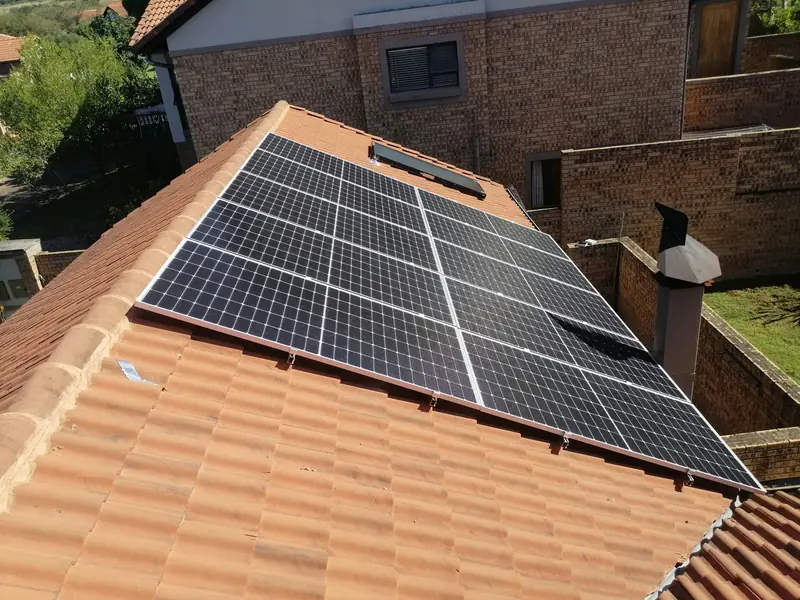
Most people start by asking for "a 6.6" or "a 10 kW" because that's what the neighbour got. That's a fair starting point, but the right size for your place comes down to four things: how much power you use, when you use it, how much good roof you have, and what your local network will let you export. Get those right and the system size more or less picks itself.
1. Start with your bill, not a brochure
Grab a recent electricity bill. Somewhere on it you'll find your usage in kilowatt-hours (kWh) for the billing period, and often a daily average. Many retailers also show the same period last year. If you can, look at a summer bill and a winter bill, because usage in Sydney swings with air conditioning in summer and heating in winter.
Daily usage is the number that matters most. A household using a small amount each day needs a very different system from one running a pool pump, ducted air con and an electric hot water system. If you have a smart meter, your retailer or your distributor can usually give you interval data showing usage every 30 minutes, which is even better.
2. When you use power matters as much as how much
Solar panels make power during the day, peaking around the middle of the day. Power you use as it's being made is the most valuable, because it replaces electricity you would otherwise buy at full retail price. Power you don't use gets exported to the grid, and the feed-in tariff you're paid for exports is usually much lower than what you pay to buy power.
So a household that's home during the day (working from home, retirees, young kids, a pool pump on a timer) gets more out of every panel than one where everyone is out from 7 am to 6 pm. If most of your usage is in the evening, you have two options: shift what you can into the day (dishwasher, washing machine, hot water on a timer, pre-cooling the house), or add a battery to carry daytime solar into the evening. Our guide Is a home battery worth it in NSW? covers that side.
3. Your roof sets the upper limit
The roof decides how many panels physically fit and how well they'll perform:
- Direction. In Sydney, north-facing roofs produce the most over a year. East and west roofs still work well, and they spread production into the morning and afternoon, which can suit households who use more power at those times. South-facing roofs produce noticeably less and are usually a last resort.
- Shade. Trees, neighbouring buildings, chimneys and even a TV antenna can cut output. We check shading as part of the design and can use panel-level electronics where partial shade is unavoidable.
- Roof type and condition. Tile, Colorbond and other metal roofs are all fine, but they use different mounting. If the roof is due for replacement soon, it's worth doing that first.
- Usable space. Vents, skylights, hips and valleys all eat into the area you can use. A roof that looks big from the street can fit fewer panels than you'd think.
4. Network export limits
Across Greater Sydney, your local electricity network is run by one of the distributors (Ausgrid, Endeavour Energy or Essential Energy, depending on where you live). They set rules about how big an inverter you can connect and how much you can export, and those rules depend on your connection, for example single-phase or three-phase power. Part of our job is checking those rules and applying for connection approval before installation, so your system is designed to fit from day one.
It's common to install more panels than the inverter's rated output. Done properly and within the rules, that helps the system produce more in the mornings, afternoons and on cloudy days.
5. Plan for what's coming
Think about the next few years, not just this year's bill. Are you planning to buy an electric vehicle, swap a gas hot water system or cooktop for electric, add a pool, or install ducted air con? Each of those adds load. If a battery is on the cards, the inverter choice matters now: some systems are much easier to add a battery to later than others.
It's usually cheaper to size for what you'll need than to add a second small system later, but oversizing for a future that may not happen isn't great value either. We'll talk it through and show you the trade-off.
Putting it together
A sensible process looks like this:
- Work out your average daily usage from your bills (summer and winter if you can).
- Estimate how much of that happens during daylight hours.
- Check what fits on the roof, and which faces get good sun.
- Check the network's inverter and export rules for your connection.
- Adjust for planned changes like an EV, electric hot water or a battery.
Our savings estimator gives you a rough starting point from your quarterly bill and shows the assumptions it uses. A proper design goes further: we look at your actual roof using satellite imagery (with a site visit where needed), your usage, and your network's rules, and then give you a written quote with the system size explained.
A few things to be wary of
- One-size-fits-all quotes. If a quote doesn't mention your usage or your roof, it isn't designed for you.
- Panel count with no layout. Ask to see where the panels will go.
- Vague inverter details. Make sure the quote names the inverter, its size, and whether it can take a battery later.
Want us to size it for you?
Send us your details and a recent bill. We'll design a system around your usage and roof and give you a clear written quote, free and with no obligation.
More guides: What solar and batteries cost in Sydney · NSW solar and battery rebates · Is a home battery worth it in NSW? · What is a solar PPA? · Solar for strata and commercial roofs